Welcome to the era of ARKit and Unreal Engine, where your smartphone suddenly starts thinking it’s a magician’s wand. In this magical realm, your ordinary device transcends its humble origins, allowing you to manipulate reality as if you were a technologically advanced sorcerer. Today, let’s dive into how Apple’s ARKit, armed with its bag of sensors and cameras, pairs with the powerhouse Unreal Engine to turn the world around you into a playground of digital possibilities.
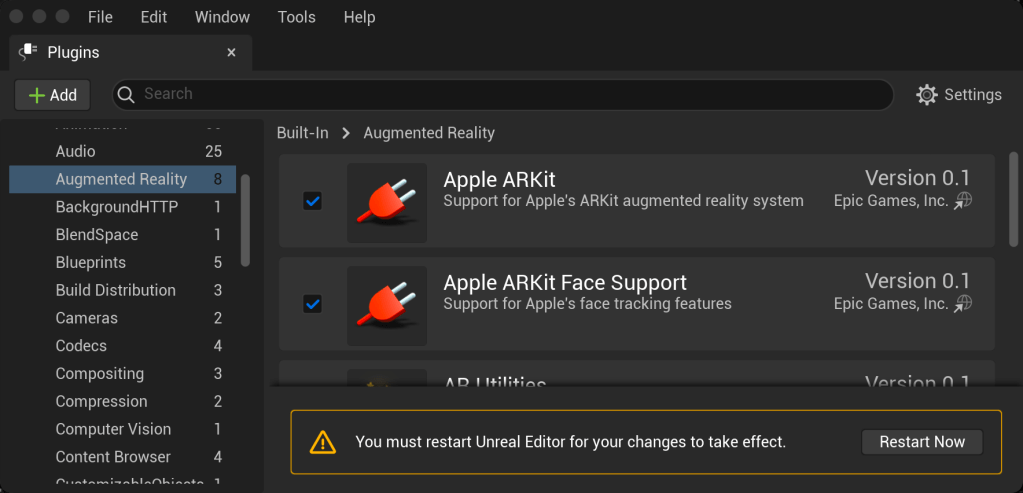
Be sure to enable Apple ARKit and Apple ARKit Face Support in your project plugins.
What is ARKit?
Imagine if your phone could not only capture selfies but also map and understand the environment around you with the precision of a cartographer. That’s ARKit. Introduced by Apple, ARKit is a framework that turns iOS devices into full-fledged augmented reality (AR) platforms. It uses the camera, processors, and motion sensors in your device to seamlessly blend digital objects with the real world. Think of it as teaching your iPhone to paint over the fabric of reality, but instead of paint, it uses bits and bytes.
Pairing ARKit with Unreal Engine: A Symphony of Code
Unreal Engine, on the other hand, is like the Mozart of 3D game development—a true virtuoso capable of creating immersive virtual worlds. When you combine Unreal Engine’s robust rendering capabilities with ARKit’s keen sense of space and motion, you get a symphony of interactive experiences that are as realistic as they are captivating.
How Are They Transforming Interaction?
1. Digital Showrooms: Imagine shopping for furniture by placing true-to-scale 3D models of sofas and tables in your living room before you buy them. ARKit and Unreal Engine make it possible to see exactly how that chaise lounge fits next to your quirky plant stand. No more relying on imagination and crossed fingers; now, you can shop with augmented confidence.
2. Interactive Learning Environments: Remember dissecting frogs in biology class? Now picture doing it without the smell of formaldehyde. Educational apps powered by ARKit and Unreal Engine can overlay complex anatomical models over your desk, turning your smartphone into a lab where the only thing at risk is your sense of wonder.
3. Virtual Tours and Travel: Want to stroll through the Louvre but stuck in your studio apartment? With ARKit and Unreal Engine, you can walk around virtual museums, explore archaeological sites, or visit distant planets without ever changing out of your pajamas. It’s time travel and teleportation, available at the tap of an app.
4. Gaming on a Whole New Level: Turn your living room into an alien battlefield or your backyard into a fantasy land. ARKit and Unreal Engine elevate gaming to new dimensions, where your environment becomes the canvas for gameplay. Now, those zombies aren’t just on your screen; they’re coming up your driveway.
5. Home Renovation and Interior Design: For those who constantly rearrange their furniture, why not try out new home improvements in AR first? Test wall colors, decor placements, or complete renovation ideas in AR before the first drop cloth is laid down. It’s like having a preview button for your DIY projects.
Conclusion: Magic or Just Advanced Technology?
As Arthur C. Clarke famously said, “Any sufficiently advanced technology is indistinguishable from magic.” With ARKit and Unreal Engine working in tandem, the line between the two becomes blurrier than ever. Your iOS device isn’t just a piece of technology; it’s a portal to a world where the digital and physical coalesce, creating experiences that were once relegated to the realm of science fiction.
So grab your iPhone, open your augmented eyes, and step into a world where Unreal Engine and ARKit transform the mundane into the magical. Who needs a magic wand when you have a smartphone?